
Introduction: The Silo Struggle is Real
In most companies, the technology, marketing, and web teams operate in separate worlds. The tech department manages the operational engine, marketing crafts the public voice, and the website exists as a digital hub. This separation creates friction, slows down projects, and makes it nearly impossible to get a clear view of business performance.
But what if these functions weren't separate at all? A new, integrated approach is gaining traction, designed to break down these traditional barriers. This article distills five surprising and impactful takeaways from one company's blueprint for modern business growth, offering a practical look at how to build for scale, not silos.
1. Stop Selling Services, Start Building Ecosystems
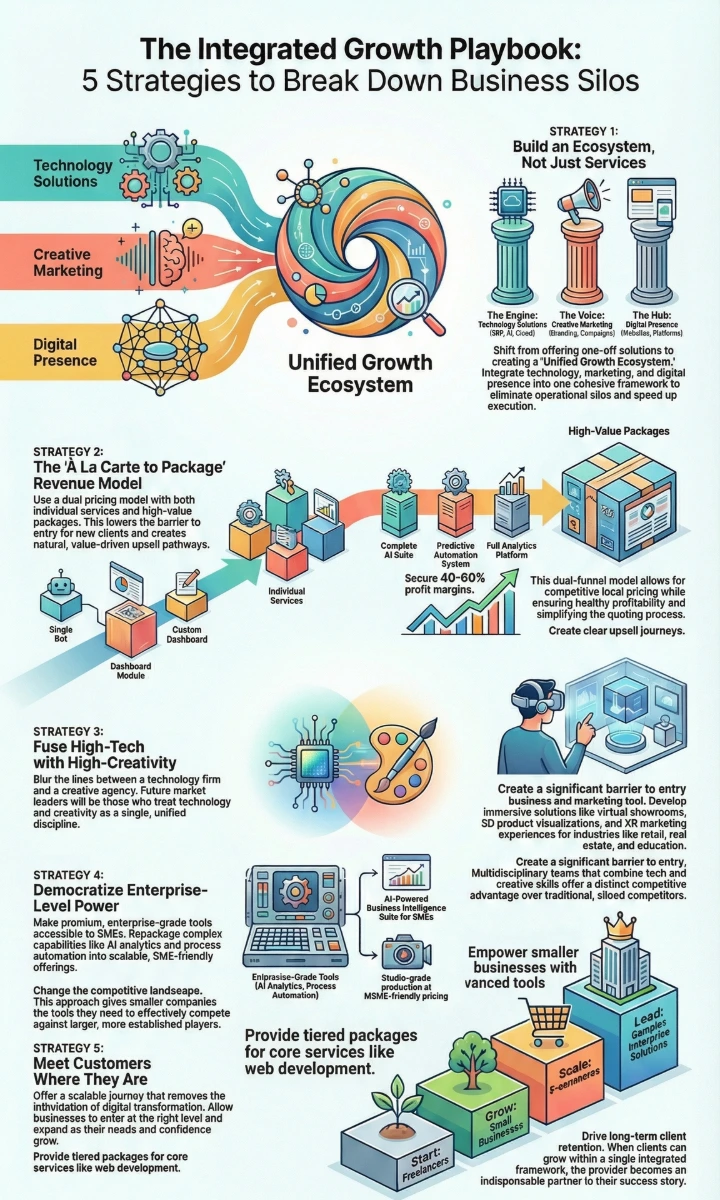
The first major shift is moving away from offering one-off, isolated solutions. Instead, the focus is on creating a "Unified Growth Ecosystem" where every service is interconnected. This model is built on three pillars that work together, not in isolation:
- The Engine: Technology Solutions like ERP, AI, and cloud infrastructure that form the operational backbone.
- The Voice: Creative Marketing that handles branding and campaigns to build influence.
- The Hub: Digital Presence, including websites and platforms, that unifies the customer journey.
The goal is to eliminate the operational and marketing silos that hinder growth. By integrating these functions, businesses can achieve faster execution and generate clearer, more actionable insights.
We do not operate as a traditional service provider delivering isolated solutions. Instead, GBTECH integrates technology, creative marketing, and digital presence into one cohesive growth framework designed to scale with our clients’ ambitions.
2. The Strategic 'À La Carte to Package' Revenue Model
A common challenge is balancing comprehensive, high-value packages with the need to attract clients who aren't ready for a full commitment. A surprisingly effective solution is a dual pricing model that offers both large packages and a modular, à-la-carte menu of individual services.
This approach creates natural, value-driven upsell pathways. A client can start with a small, specific need and seamlessly scale up as their confidence and requirements grow.
- A client buying a custom dashboard can be upsold to a full predictive AI package.
- A client purchasing a CRM implementation can be upsold to the complete MarTech stack.
- A client starting with a single RPA bot can be upsold to a full automation suite.
This dual-funnel approach does more than just lower the barrier to entry for clients. From a business perspective, it's a shrewd financial and market-positioning tool. It allows the company to remain competitive with local market pricing in regions like Malaysia, simplifies the complex quoting process, and strategically ensures healthy profit margins of 40-60%—all while creating natural, value-driven roadmaps for long-term, high-value partnerships.
3. Your Next Marketing Campaign Might Be in Virtual Reality
The line between a technology firm and a creative agency is becoming increasingly blurred. The most forward-thinking growth strategies involve a fusion of high-end tech and creative marketing, exemplified by the emergence of XR (Extended Reality) Business Solutions.
Instead of being a niche tech offering, virtual and augmented reality are being positioned as powerful marketing and business tools. This includes developing applications such as:
- Virtual showrooms and offices
- Immersive training modules
- 3D product visualization
- XR marketing experiences
This fusion is finding fertile ground in sectors like retail, real estate, education, and corporate training, where immersive experiences offer a distinct competitive advantage. This trend signals a critical insight: future growth doesn't lie in choosing between being a "tech company" or a "creative agency," but in mastering the discipline of combining both. This signals a fundamental shift where future market leaders will be those who can build multidisciplinary teams that treat technology and creativity as a single, unified discipline, creating a significant barrier to entry for traditional, siloed competitors.
4. Enterprise Power Is No Longer Just for the Enterprise
Historically, the most powerful business tools—like AI-driven analytics, process automation, and studio-grade content production—were reserved for large enterprises with deep pockets. A counter-intuitive but powerful strategy is to democratize access to these premium, enterprise-level services, making them accessible to smaller and mid-sized businesses (SMEs).
This is achieved by repackaging complex capabilities into scalable, SME-friendly offerings.
- Offering an "AI-POWERED BUSINESS INTELLIGENCE SUITE" to data-driven SMEs and corporates, giving them the predictive capabilities once reserved for large corporations.
- Providing "Studio-grade production at MSME-friendly pricing" specifically for small businesses wanting professional content, bridging the quality gap.
- Positioning the company as a "premium but still SME-accessible tech partner."
This approach changes the competitive landscape by empowering smaller companies with the advanced tools they need to compete effectively against larger, more established players.
5. The Best Growth Strategy? "Start Where You Are."
Many businesses delay digital transformation because the process feels overwhelming and expensive. The most effective growth philosophy meets customers where they are, offering a scalable journey that removes this intimidation factor.
A tiered pricing model for a core service like website development provides a clear example of this philosophy in action. It allows a business to enter at the right level and expand as its needs evolve.
- Start Package: For freelancers needing a simple one-page presence.
- Grow Package: For small businesses that require a few core pages to tell their story.
- Scale Package: For growing businesses ready for e-commerce and booking systems.
- Lead Package: For enterprises that need complex, custom-built solutions.
This approach does more than make sophisticated solutions accessible; it is the cornerstone of long-term client retention. By enabling a client to seamlessly move from a "Start" package to a "Scale" solution, it reinforces the value of the unified ecosystem. As their needs grow, they don't have to find a new technology partner, a separate marketing agency, or a different web developer—they simply expand within the same integrated framework, making the provider an indispensable part of their growth story.
Conclusion: Are You Built for Silos or for Scale?
The overarching theme is clear: the future of business growth is integrated, scalable, and relentlessly customer-centric. Breaking down the walls that traditionally separate technology, marketing, and digital presence is no longer a competitive advantage—it is becoming a baseline requirement for survival and success.
As you look at your own business, are your tools and teams working in isolated silos, or are they part of a unified ecosystem built for growth?